


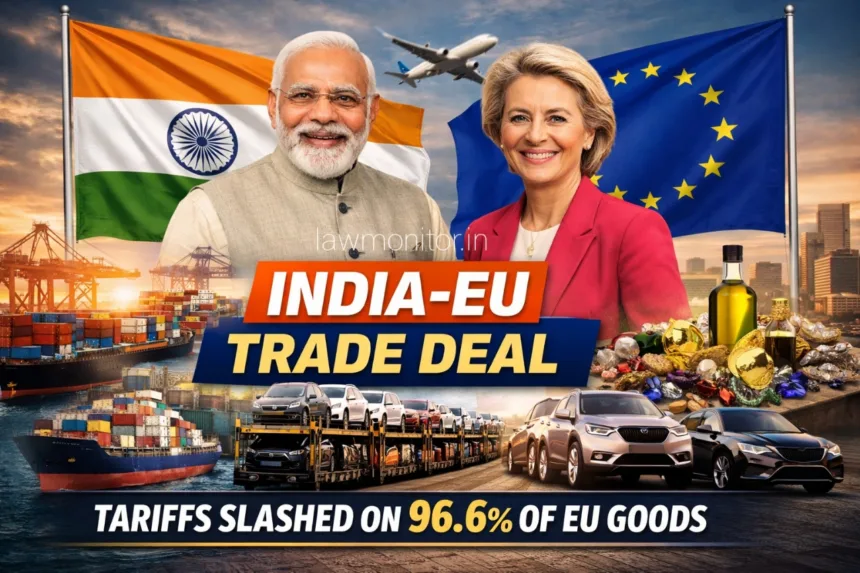
The Government of India has officially announced a historic trade deal with the European Union (EU), aimed at boosting bilateral commerce between the two major economies. According to sources familiar with the agreement, under this deal, tariffs on 96.6% of products exported from the EU to India will either be reduced or completely eliminated.
Prime Minister Narendra Modi made the announcement today. A formal joint statement from both India and the EU is expected to follow later in the afternoon.
Under the agreement:
- Tariffs on EU automobiles will be reduced to 10%. Around 250,000 passenger vehicles imported annually from the EU will benefit from this lower tariff.
- Tariffs on other EU goods, including machinery, pharmaceuticals, and chemicals, will also be substantially lowered or removed.
The deal is being seen as a major step forward in strengthening trade and economic ties between India and the European bloc. It is expected to significantly increase mutual trade volumes and provide enhanced market access.
In addition to tariff reductions, the agreement includes several sector-specific changes:
- Tariff on EU alcohol imports: Reduced to about 40%.
- Tariff on EU beer imports: Reduced to about 50%.
- Tariff on EU olive oil and edible oils: Completely removed.
- Tariffs on fruit juices and processed food products: Fully removed.
The EU has also committed to provide financial support worth €50 crore to India, and assist in reducing greenhouse gas emissions.
The deal also encompasses a security and defence cooperation agreement between India and the EU, marking deeper strategic engagement beyond trade.
According to economic policy analysts, India’s garment, textile, and gems & jewellery sectors are expected to benefit from the tariff concessions extended by the EU on these goods.
In summary, the India-EU trade deal represents a major milestone in economic relations between the world’s fastest-growing large economy and a major trade bloc, and is expected to significantly expand business opportunities for exporters and importers on both sides.
