


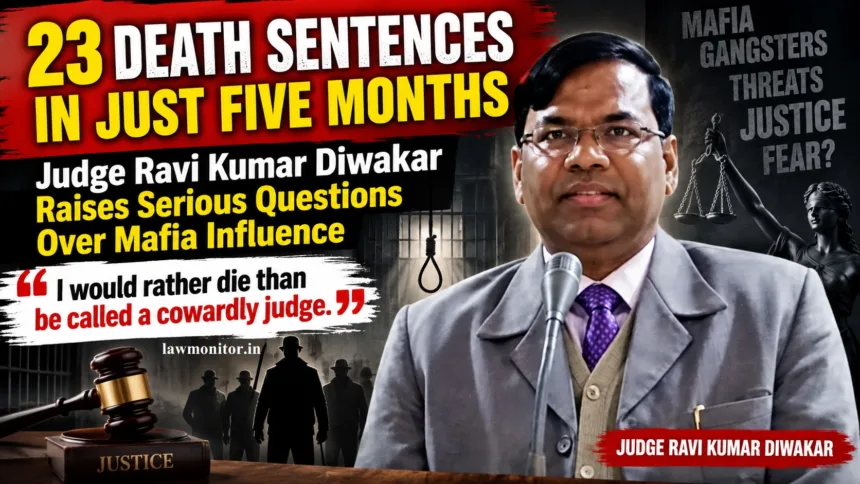
“I would rather die than be called a cowardly judge.”
These strong words from Muzaffarnagar Additional District and Sessions Judge Ravi Kumar Diwakar have drawn attention to concerns over alleged mafia and gangster influence in the judicial system of western Uttar Pradesh. The statement came after Justice Diwakar awarded his 23rd death sentence in just five months.
On Monday, September 7, 2026, the court sentenced Mohammad Nadeem to death for the murder of his wife, Shahjadi, in a dowry-related case. The court described the killing as “extremely cruel and barbaric” and classified it under the “rarest of rare” category warranting capital punishment.
The case dates back to July 2018. According to the prosecution, Nadeem allegedly poured kerosene on his wife and set her on fire. During the trial, several prosecution witnesses, including Shahjadi’s parents, reportedly turned hostile and denied allegations of dowry demands and harassment.
Despite this, the court relied heavily on Shahjadi’s dying declaration, observing that it clearly established Nadeem’s role in the crime.
Judge Speaks Out Against Alleged Mafia Pressure
The significance of the judgment, however, extended beyond the death sentence itself. While delivering the verdict, Judge Diwakar raised serious questions about the alleged influence of mafias and gangsters over the criminal justice system in western Uttar Pradesh.
He expressed concern over instances where criminal cases are allegedly delayed, withdrawn or otherwise affected under pressure. According to him, judges must be able to perform their constitutional duties without fear or external influence.
Diwakar said he had been “deeply hurt and saddened” by certain recent developments, which compelled him to express his personal views. He claimed that he knew why some criminal cases had been withdrawn from his court but declined to disclose the details, saying he wanted to maintain the dignity of his office.
The judge further alleged that after certain case files were withdrawn, he received a message purportedly from a gangster warning that if he pursued the matter or made comments about it, he could be transferred to another court or moved out of the district.
“My Parents Taught Me to Fear Only God”
Judge Diwakar said his parents had taught him to fear only God. If a judge begins to fear the mafia, he argued, public confidence in the judiciary could be seriously undermined.
It was in this context that he made his striking remark:
“I would rather die than be called a cowardly judge.”
He also made it clear that he would continue serving in the judiciary as long as he was able to work according to his principles. If circumstances made that impossible, he said, he would choose to resign.
Judge Diwakar Has Faced Controversy and Threats Before
Ravi Kumar Diwakar has previously been in the spotlight. During his posting in Varanasi, he played an important role in proceedings concerning permission for a survey of the Gyanvapi mosque complex. He has since claimed that he and his family received multiple death threats following that case.
He has also alleged that the local administration did not provide adequate security and that his security cover was subsequently reduced.
During his remarks, Diwakar referred to proceedings involving Abbas Ansari in Chitrakoot and Maulana Tauqeer Raza in Bareilly, while also recalling cases involving judicial officers who were killed after dealing with serious criminal matters.
Among the incidents he mentioned were the 1982 killing of Allahabad High Court judge Justice Chandrashekhar Prasad Singh and his teenage son, the 2001 murder of Lakhimpur Kheri Chief Judicial Magistrate Balaram, and the 2021 killing of Dhanbad Additional District and Sessions Judge Uttam Anand.
A Bigger Question for the Judiciary
According to Diwakar, such incidents demonstrate the risks faced by judicial officers handling serious criminal cases, particularly when powerful criminal networks are involved.
Therefore, the most significant aspect of his 23rd death sentence may not be the punishment itself, but the larger question raised by his remarks:
Can judges truly deliver judgments freely and fearlessly when they are dealing with powerful criminals, mafias and external pressure?
His statement has once again brought the issue of judicial independence, security of judges and public confidence in the justice system into sharp focus.
